
Virtual Reality and Chronic Pain: How Therapeutic Distraction Reduces Pain Intensity in Your Patients
Chronic pain affects approximately 19% of adults and represents one of the leading reasons for seeking physiotherapy care [1]. Virtual reality (VR) is now establishing itself as a non-pharmacological clinical tool whose effects on pain intensity are documented by robust meta-analyses. A systematic review published in 2025 covering 56 studies confirms the relevance of VR in chronic pain rehabilitation [2]. For chronic low back pain, pooled data from 11 randomised trials show a significant reduction in pain intensity in favour of VR (SMD = −1.92, p < 0.00001) [3]. These results concretely change the way you can support your chronic pain patients in practice.
The daily challenge of chronic pain in physiotherapy
Chronic pain is not simply pain that lasts. It is a complex neurobiological phenomenon, sustained by central sensitisation mechanisms, altered attentional modulation, and often a significant psycho-cognitive component — catastrophising.
For you, as a physiotherapist, this translates into patients who arrive exhausted, watchful of the slightest painful provocation, and who struggle to fully engage in exercises. Therapeutic adherence then becomes your first clinical challenge, well before technique.
Conventional approaches — active exercise, manual therapy, pain education — remain the undisputed foundation of management. But they do not always resolve the attentional lock: that patient whose entire cognitive energy is mobilised by monitoring their pain, to the detriment of movement.
This is precisely where analgesic distraction through VR opens a complementary clinical pathway, backed by a rapidly expanding scientific literature.
💡 Discover what KineQuantum can change in your practice.

Virtual reality and pain: what the neurobiological mechanisms tell us
VR does not "hide" pain. It acts on the way the central nervous system processes it, through several distinct and complementary mechanisms.
Researchers hypothesise that VR acts as a form of non-pharmacological analgesia by engaging attentional, emotional and cognitive processes within the complex pain modulation system.
1. Attentional competition: since attentional resources are limited, a distraction activity that consumes a portion of these resources leaves less cognitive capacity available for processing pain. Immersion in a virtual environment simultaneously engages visual, auditory and, depending on the protocol, proprioceptive channels — thereby saturating the processing pathways.
2. Descending modulation: unlike many analgesics that disrupt the C-fibre pathway relaying nociceptive signals to the central nervous system, VR affects pain perception through attention, concentration and emotions. This is a top-down, cognitive pathway that complements the bottom-up approaches of manual therapy.
3. The effect on catastrophising: a meta-analysis (2025) of adults suffering from chronic musculoskeletal pain found a significant, albeit moderate, effect of VR interventions on catastrophising (SMD = −0.26 [−0.48; −0.04]). Psycho-cognitive interventions — relaxation, mindfulness, biofeedback — achieved the most marked effects [4].
4. Neuroimaging as evidence: a neuroimaging study demonstrated a reduction in brain activity in regions involved in pain perception during VR sessions. The modulation is therefore not purely subjective — it is measurable.
The clinical evidence: what the studies actually say
The literature on VR and virtual reality pain has matured considerably over the past five years. Meta-analyses are no longer merely cataloguing pilot studies — they are aggregating randomised controlled trials of increasing quality.
Approximately 19% of adults report chronic pain, representing a considerable physical, mental and economic burden. Faced with this reality, several research teams have sought to rigorously evaluate the contribution of VR.
A meta-analysis of 11 randomised trials (n = 569) concludes that VR significantly reduces pain intensity (SMD = −1.92; p < 0.00001) and kinesiophobia (MD = −8.96; p = 0.04) in patients suffering from chronic low back pain.
For chronic low back pain, non-immersive VR proves effective in the short term for reducing pain (SMD = −1.79; p < 0.001), improving disability and reducing kinesiophobia, with effects maintained at 6 months for pain (SMD = −8.15; p = 0.03) compared to conventional exercise.
A recent exploratory meta-analysis of 13 randomised trials (n = 881 participants) with chronic musculoskeletal disorders concludes that pain, function and quality of life improve in the majority of studies including VR interventions.
Finally, immersive and psycho-cognitively oriented VR interventions show potential for reducing pain catastrophising , that negative prognostic factor so difficult to target with physical tools alone [4].
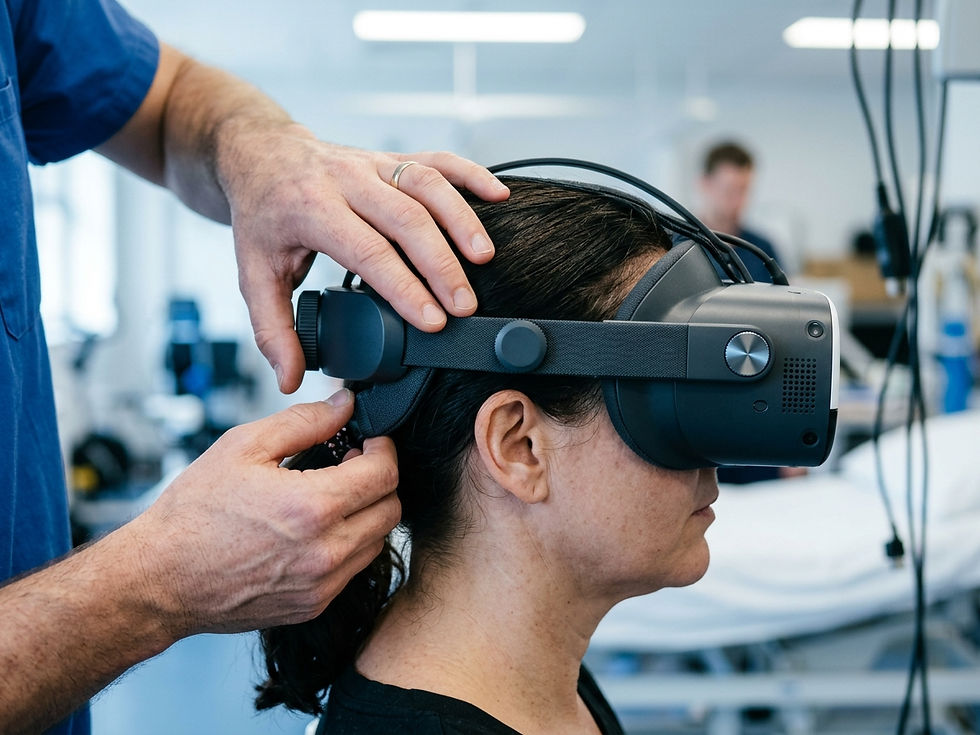
Virtual reality and low back pain: an emblematic clinical case
Chronic low back pain represents the most documented indication for analgesic VR. Chronic low back pain significantly impacts quality of life, highlighting the need for safe and accessible non-pharmacological therapies.
A recent randomised trial compared three VR modalities for chronic low back pain: skills-based VR (biofeedback, interoceptive training, relaxation), distraction VR (immersive 360° videos), and sham VR (2D videos), across 385 participants.
Secondary outcomes indicate a greater reduction in daily opioid consumption in the distraction VR group compared to the sham VR group (p = 0.009). A result that concretely illustrates the medication-sparing potential of therapeutic distraction.
For your chronic low back pain patients, VR is not an alternative to active exercise: it is its facilitator. By lowering the perceived effort threshold and reducing pain anticipation, it enables your patients to achieve ranges of movement they had previously refused.
Who are the right candidates? Patient profile and protocol parameters
Not all chronic pain responds identically to analgesic distraction through VR. Identifying the right patient profiles is a clinical step in its own right.
Higher levels of VR immersion appear to improve engagement, motivation and sense of presence in patients with chronic pain, while providing a distracting effect on pain that may improve coping strategies and rehabilitation effectiveness.
Favourable indicators in your patients:
Chronic musculoskeletal pain with a central component (low back pain, neck pain, fibromyalgia)
High catastrophising score (assessed by the PCS — Pain Catastrophizing Scale)
Kinesiophobia hindering progression of active exercises
Anticipatory anxiety related to movement
Low therapeutic adherence despite stated motivation
Precautions to take into account:
History of photosensitive epilepsy (formal contraindication)
Severe vestibular disorders (risk of cybersickness)
Unstabilised psychiatric disorders
Severe claustrophobia incompatible with wearing the headset
Patient profile | Characteristic |
|---|---|
Primary target condition | Low back pain, neck pain, chronic fibromyalgia |
Psycho-cognitive component | Catastrophising, kinesiophobia |
Primary objective | Facilitate active movement |
Main contraindication | Photosensitive epilepsy |
Protocol parameter | Recommended value |
|---|---|
Duration per session | 10 to 20 minutes |
Frequency | 2 to 3 sessions per week |
Number of sessions | Minimum 6 to 12 sessions |
Supervision | Direct in-practice, mid-course reassessment |
💡 Key takeaway: VR does not replace clinical assessment or neurophysiological pain education. It integrates into a multimodal management approach: therapeutic patient education (TPE), progressive active exercise and, where needed, cognitive behavioural therapy. The initial VR assessment enables objective documentation of baseline status and measurement of progress throughout sessions.
⚠️ Key point: Several studies have suggested that there are alternative mechanisms, beyond simple distraction, through which VR may be able to reduce chronic pain. Do not reduce VR to a mere "immersive pastime": content quality, immersion level and clinical guidance are therapeutic variables in their own right. Poor use can even prove counterproductive if it reinforces avoidance behaviours.
How KineQuantum transforms this science into concrete results
From research to your daily practice, the challenge is to make these mechanisms accessible and reproducible in your practice, without organisational overload.

1. Clinically oriented content — KineQuantum offers immersive environments specifically designed for pain management and therapeutic relaxation: guided meditation in natural settings, breathing exercises with visual biofeedback, soothing sensory stimulations. Each piece of content engages the attentional mechanisms described in the literature.
2. Objective pain monitoring — The VAS scale (Visual Analogue Scale) and functional scores are integrated directly into the platform, session by session. You have access to traceable assessment data that can be used to adapt your protocol and clinically justify your approach.
3. Integration into care, not alongside it — The KineQuantum device is used during sessions, under your direct supervision. The KineQuantum Liberté tool allows great flexibility in positioning within your care space, including in a lying or partial weight-bearing position.
4. Compatibility with active exercise — VR can be used as distraction during a gentle mobilisation exercise, in preparation before a more demanding technique, or during recovery. It adapts to your clinical reasoning, not the other way around.
5. A citable scientific base — The scientific studies referenced by KineQuantum enable you to communicate clearly with your patients and, where necessary, with other healthcare professionals involved in chronic pain management.
Analgesic distraction: a clinical lever in its own right
Virtual reality and chronic pain now form a documented clinical field, supported by randomised trials and high-level meta-analyses. This is no longer a technological promise — it is a tool you can integrate right now, with defined protocols and clear selection criteria.
Your chronic pain patients deserve management that goes beyond analgesics and isolated exercise. Therapeutic distraction through VR offers them an active, engaging experience that is neurobiologically consistent with what we know about central pain modulation.
As a physiotherapist, you have the training to understand these mechanisms, the therapeutic relationship to contextualise them, and now the tools to apply them. The science supports you — it remains only to take the step.
FAQ
Is virtual reality effective for chronic pain, or only for acute pain?
The systematic review "Virtual Reality in Chronic Pain Rehabilitation" (J Phys Med Rehabil, 2025) specifically analyses VR applications in chronic pain management within a rehabilitation context, across 56 included studies. Available data show documented benefits on chronic musculoskeletal pain, particularly lumbar and cervical, provided the protocol is structured and supervision is ensured.
How many sessions are needed to observe an effect on pain?
VR interventions included in meta-analyses last from 3 to 12 weeks , with a variable frequency of 2 to 5 sessions per week. The first improvements in patient-reported pain intensity are generally observable from the 3rd or 4th session, but a protocol of at least 6 sessions is recommended for lasting effects. Also consult the available scientific studies for condition-specific data.
Can virtual reality replace analgesics or traditional physiotherapy?
No. while VR significantly reduces pain in patients suffering from various conditions, its mechanism relies on diverting attention, inducing a state of relaxation and reducing anxiety — making it a complement, not a substitute. It integrates into a multimodal management approach combining active exercise, therapeutic education and, where necessary, pharmacological treatment. Discover the overall approach on the VR advantages in physiotherapy page.
Which chronic low back pain patients respond best to VR?
Poor pain control can lead to kinesiophobia, maladaptive beliefs and poor adherence to rehabilitation. Therapies must be progressive, engaging and aligned with daily life activities to maintain motivation. Patients with high catastrophising, marked kinesiophobia or low exercise tolerance are precisely those who derive the greatest benefit from an analgesic distraction approach. The lumbar spine VR page details the adapted protocols.
Are there adverse effects from VR in a physiotherapy practice?
Continuous use of a VR headset is neither reasonable nor desirable. Prolonged immersion may be accompanied by side effects such as nausea and dizziness. In clinical practice, short sessions (10 to 20 minutes) and rigorous patient selection (exclusion of epileptic history, monitoring of vestibular disorders) allow these risks to be minimised. VR-related adverse events remain rare and dropout rates minimal , confirming its safety in a supervised clinical context.
💡 Would you like to integrate virtual reality into chronic pain management in your practice or centre?
📚 References
[1] Amorim P, Sousa MJ, Sousa JE, Martins H, Lee SH. Virtual Reality in Chronic Pain Rehabilitation: A Systematic Review. J Phys Med Rehabil. 2025;7(1):14-78. Voir l'article →
[2] Amorim P, Sousa MJ, Sousa JE, Martins H, Lee SH. Virtual Reality in Chronic Pain Rehabilitation: A Systematic Review. J Phys Med Rehabil. 2025;7(1):14-78. Voir l'article →
[3] Brea-Gómez B et al. Virtual Reality in the Treatment of Adults with Chronic Low Back Pain: A Systematic Review and Meta-Analysis of Randomized Clinical Trials. PMC. 2021 (données poolées, 11 RCTs, n=569). Voir l'article →
[4] Palacios-Navarro G et al. Effects of Virtual Reality-Based Interventions on Pain Catastrophizing in People with Chronic Pain: A Systematic Review and Meta-Analysis. PMC. 2025. Voir l'article →
[5] Lo HHM, Zhu M, Zou Z et al. Immersive and Nonimmersive Virtual Reality–Assisted Active Training in Chronic Musculoskeletal Pain: Systematic Review and Meta-Analysis. J Med Internet Res. 2024. Voir l'article →
[6] Maddox T et al. Randomized-controlled trial of skills-based VR vs. distraction VR vs. sham VR for chronic low back pain. npj Digital Medicine. 2026. Voir l'article →
[7] Zitti M et al. Effectiveness of Virtual Reality for Pain Management in Musculoskeletal Disorders Across Anatomical Regions: A Systematic Review and Meta-Analysis. Musculoskeletal Care. 2025;23(1):e70041. Voir l'article →


Comments