
Therapeutic Virtual Reality Headset: 5 Clinical Criteria for Choosing the Right Equipment
Therapeutic virtual reality (VR) is now established as a clinically validated tool supported by research. A meta-analysis published in the Journal of Medical Internet Research in 2025 involving 13,184 patients concludes that VR significantly improves pain and balance in musculoskeletal rehabilitation [1]. Another meta-analysis (JMIR, 2025) including 24 randomised controlled trials demonstrates that VR therapy significantly improves the BBS (Berg Balance Scale) score in post-stroke patients compared to conventional rehabilitation [2]. But not all headsets are equal: between consumer equipment and a CE-marked medical device, the differences are considerable — and they can put your professional liability at stake.
The physiotherapist's challenge in the face of an overwhelming range of VR headsets
The virtual reality headset market has exploded in just a few years. There are now dozens of models available, at prices ranging from a few dozen to several thousand euros.
For an independent physiotherapist, this abundance is a double-edged sword. It reflects the clinical interest of the technology — but it makes choosing difficult, and even risky if one confuses a consumer product with an approved clinical tool.
The question is therefore not "which headset is the most well-known?" but "which headset meets my professional obligations and my patients' needs?" This clinical guide helps you structure your thinking around five concrete criteria.
💡 Discover what KineQuantum can change in your practice.
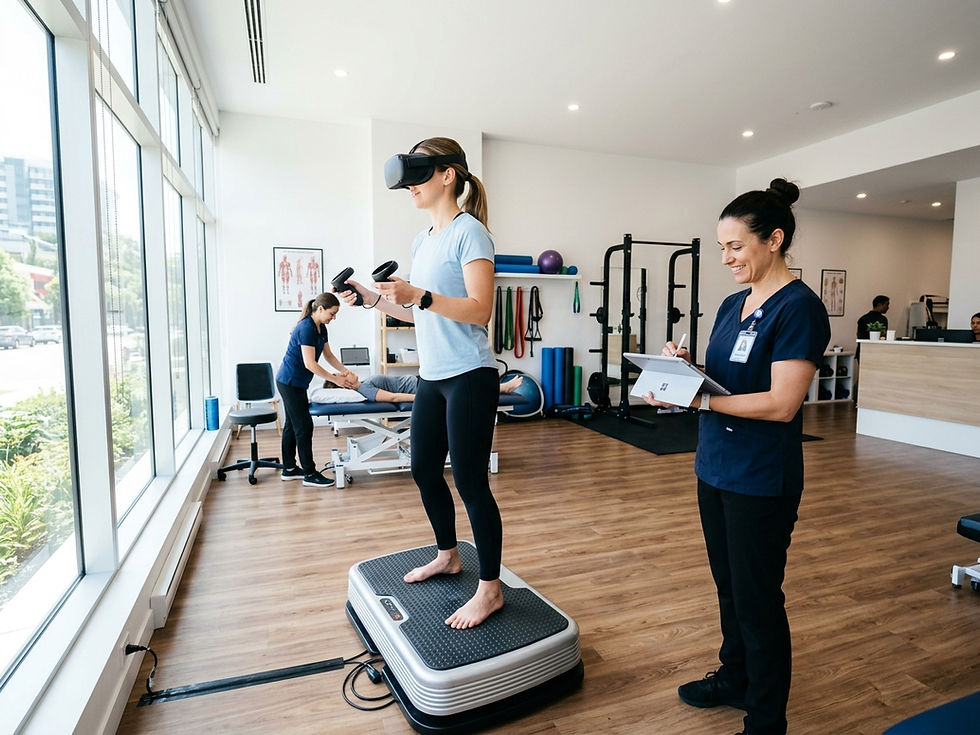
Criterion no. 1 — Medical device or consumer product: a fundamental distinction
This is the most important criterion, and yet the most frequently overlooked at the time of purchase.
A consumer VR headset (gaming, entertainment) is not subject to any specific health regulations. It was not designed or validated for therapeutic use on vulnerable, neurological, or vestibular patients.
A therapeutic virtual reality headset bearing the Class I CE marking is, by contrast, a medical device within the meaning of European regulation MDR 2017/745. Its manufacturer assumes obligations regarding traceability, vigilance, and clinical documentation. In the event of an incident, your liability is protected — which is not the case if you use a non-approved product on a patient.
The clinical rule: if a VR tool forms part of your therapeutic process and influences your clinical decisions, it must be a CE-marked medical device. This is non-negotiable for compliant professional practice.
Criterion no. 2 — Motion sensors and clinical monitoring
A therapeutic virtual reality headset does not simply serve to immerse the patient in a virtual environment. It must measure and record what the patient is doing.
This is where sensor quality makes all the difference between a simple entertainment tool and a genuine assessment and rehabilitation tool.
1. Head tracking: the precision of head tracking (accelerometer, gyroscope, magnetometer) is crucial for vestibular, cervical, and balance exercises. Poor tracking generates poorly calibrated exercises — and potentially counterproductive ones.
2. Limb tracking: depending on your speciality, you will need sensors for the upper limbs (shoulder, elbow, wrist) or lower limbs (knee, hip, ankle). Check whether controllers are included and whether their precision is sufficient for usable joint measurements.
3. Data export: a good therapeutic virtual reality headset must allow you to export objective measurements (range of motion, reaction time, balance score) that can be integrated into your patient record. Without traceability, rigorous assessment is impossible.
Criterion no. 3 — Headset ergonomics: put your patient first
Meta-analyses show a significant positive impact of VR interventions with a moderate to large therapeutic effect — but this effect rests on one condition: that the patient agrees to wear the headset and use it regularly.
Ergonomics is therefore a clinical criterion, not merely a commercial one.
1. Weight: a heavy headset quickly fatigues the cervical spine, particularly in neurological, elderly, or pain-affected patients. Look for a device whose weight is well distributed between the front and back of the head.
2. Interpupillary adjustment: the interpupillary distance (IPD) must be adjustable to suit each patient. A poorly adjusted headset causes visual discomfort, nausea, and rejection — all of which compromise therapeutic adherence.
3. Wearing time: VR rehabilitation sessions generally last between 10 and 30 minutes. The headset must be comfortable for this duration, with sufficient ventilation to prevent fogging and overheating.
4. Hygiene between patients: a facial interface that is easily removable and cleanable is essential in an independent practice. This is a criterion that is often underestimated at the time of purchase.

Criterion no. 4 — The exercise catalogue: the clinical richness of the library
A therapeutic virtual reality headset without a relevant clinical exercise catalogue is nothing but an empty shell.
An umbrella review (JMIR, 2025) synthesising 14 meta-analyses and 13,184 patients shows that VR produces significant results in musculoskeletal rehabilitation, particularly for knee pain and balance [1]. But these benefits are only accessible if the exercises offered by the system genuinely correspond to your patients' pathologies.
1. Pathological coverage: your catalogue must cover the main areas of your practice. Vertigo and vestibular disorders, balance and falls prevention, neurology (stroke, MS, Parkinson's), upper and lower limbs, cervical and lumbar spine, chronic pain — all fields that warrant specific, graduated exercises.
2. Progressiveness: exercises must be adjustable in difficulty. A patient in the acute phase does not have the same needs as a patient in the consolidation phase. Without progressiveness, there is no tailored rehabilitation.
3. Regular updates: the catalogue must evolve with the scientific literature and clinical feedback. A system that is frozen at the time of purchase quickly becomes obsolete.
Clinical domain | Examples of expected exercises |
|---|---|
Vestibular / vertigo | Repositioning manoeuvres, VOR, gaze stabilisation |
Balance / neurology | Weight transfers, dual task, virtual unstable surface |
Upper limb | Shoulder flexion-extension, pronation-supination, object grasping |
Lower limb | Guided squat, stair climbing, proprioceptive retraining |
Cervical spine | Cervical range of motion, neck-eye coordination |
Chronic pain | Guided relaxation, graded exposure, cognitive distraction |
Criterion no. 5 — Autonomy and conditions of use in an independent practice
One final criterion that is often decisive: the therapeutic virtual reality headset must be able to integrate into the real rhythm of an independent practice.
Conventional vestibular rehabilitation requires significant time and resources, particularly in poorly compliant patients — which limits its effectiveness and precise implementation [3]. VR must solve this problem, not create new ones.
1. Battery life: a full day of consultations requires a headset capable of lasting several hours without recharging. Check the real-world battery life (not the figure advertised under optimal conditions).
2. Standalone vs. wired mode: a wired headset (connected to a PC) restricts movement and complicates setup. A standalone headset offers greater freedom of movement for dynamic exercises.
3. Ease of use: you should not have to spend ten minutes configuring the system between patients. The exercise selection interface must be quick, intuitive, and accessible without advanced IT training.
4. Technical support and training: a serious manufacturer accompanies you during installation, trains you in use, and remains available in the event of a breakdown. This is a selection criterion in its own right.
Parameter | To check before purchase |
|---|---|
Regulatory status | CE marking as a medical device (Class I minimum) |
Sensors | 6DoF tracking, clinical data export |
Headset weight | Under 600 g recommended |
Battery life | ≥ 2 hours in continuous use |
Hygienic interface | Removable and washable facial cushion |
Exercise catalogue | ≥ 5 clinical domains covered, built-in progressiveness |
Manufacturer support | Training included, responsive after-sales service |
💡 Key takeaway: the price of a therapeutic virtual reality headset does not always reflect its clinical value. A consumer headset at €400 can cost far more than an approved medical device if its use puts your professional liability at risk or if it generates a high rate of patient rejection.
⚠️ Key point: therapeutic VR does not replace your clinical expertise — it multiplies it. The mechanisms of action identified in the literature include distraction, neuromodulation, graded exposure, and improved therapeutic adherence [4]. These effects only occur if the equipment is suited to the pathology and correctly integrated into your protocol.
How KineQuantum translates this science into concrete results
From research to your daily practice.
A meta-analysis (JMIR, 2025) covering 24 randomised trials and 768 participants shows that VR therapy significantly improves the BBS score (mean difference 3.29 points), TUG (Timed Up and Go), and step length in post-stroke patients compared to conventional rehabilitation [2]. KineQuantum was designed so that you can transpose these results directly into your practice.

1. A medical device status that protects your practice — KineQuantum is CE-marked Class I as a medical device. You work with a compliant, documented, and traceable clinical tool.
2. Two configurations adapted to your organisation — KineQuantum Liberté is the wireless standalone headset, ideal for practices seeking total mobility and rapid setup. KineQuantum Classique integrates additional external sensors for the most precise assessments, particularly suited to hospital technical platforms and rehabilitation centres.
3. A clinical catalogue covering your main pathologies — vertigo and vestibular disorders, neurology (stroke, MS, Parkinson's), balance and falls prevention, upper limb, lower limb, cervical spine, low back pain, and chronic pain.
4. Exportable objective assessments — each session generates quantified data (ranges of motion, scores, reaction times) that can be consulted and archived, for rigorous monitoring of each patient's progress. Full details are available on the VR physiotherapy assessments page.
5. Ongoing training and support — the KineQuantum team supports you through onboarding, regularly updates the exercise catalogue, and remains available to support you in your daily practice.
Your therapeutic virtual reality headset: a reasoned clinical investment
Choosing a therapeutic virtual reality headset means above all choosing a clinical tool — with the same standards as any other piece of equipment in your practice.
Meta-analyses confirm a significant and large effect on balance, and a moderate effect on gait, of interventions combining therapeutic exercise and VR training compared to control groups [5]. These results are now sufficiently robust to justify the investment — provided the selected equipment is equal to the challenge.
The five criteria presented in this article — regulatory status, sensor quality, ergonomics, catalogue richness, and day-to-day practicality — provide a reliable framework for avoiding the pitfalls of technological marketing that is disconnected from clinical reality.
Your patients deserve a validated tool. Your practice deserves a safe tool. And your time deserves a simple tool.
FAQ
What is the difference between a consumer VR headset and a therapeutic virtual reality headset? A consumer headset is designed for video gaming or entertainment and is not subject to any medical regulations. A therapeutic virtual reality headset is a CE-marked medical device, designed for clinical use, with traceability and health vigilance obligations. Using a consumer headset in a therapeutic context may put your professional liability at risk in the event of an incident.
How much does a therapeutic VR headset for physiotherapists cost? The price varies depending on the level of certification, sensor quality, and the included exercise catalogue. A complete, approved medical device represents a significant investment, but should be considered over the duration of use, the new care pathways it makes possible, and the clinical added value it provides. Some manufacturers offer packages that include maintenance and catalogue updates. Always request a detailed quote that includes initial training.
Is therapeutic virtual reality reimbursed by the French Health Insurance (Assurance Maladie)? To date, therapeutic VR is not listed as a standalone reimbursable act in France. It is integrated into an overall physiotherapy session and can enhance your care provision without altering the conventional fee schedule. The regulatory situation is evolving: check regularly with your professional association for the latest updates.
Which conditions can I treat with a therapeutic virtual reality headset in an independent practice? Indications validated by recent scientific literature include vestibular disorders (BPPV, neuritis, Ménière's disease), neurological conditions (stroke, MS, Parkinson's, traumatic brain injury), balance disorders and falls prevention, musculoskeletal conditions (shoulder, knee, spine), and chronic pain. KineQuantum's dedicated scientific studies page lists the clinical evidence by domain.
How many sessions are needed to see results with therapeutic VR? The scientific literature shows significant effects from an average of 8 to 12 sessions, depending on the pathology and frequency. Meta-analyses report a moderate to large therapeutic effect size (Hedges' g = 0.66, p < 0.001) for VR interventions in physical rehabilitation [6]. In practice, many physiotherapists observe improvements in motivation and adherence from the very first sessions, which supports therapeutic progress.
💡 Would you like to integrate a therapeutic virtual reality headset into your practice or centre?
📚 References
[1] Tao Y. et al., 2025. The Efficacy of Virtual Reality on the Rehabilitation of Musculoskeletal Diseases: Umbrella Review. Journal of Medical Internet Research. Voir l'article →
[2] Chen X. et al., 2025. Effect of Virtual Reality–Based Therapies on Lower Limb Functional Recovery in Stroke Survivors: Systematic Review and Meta-Analysis. Journal of Medical Internet Research, e72364. Voir l'article →
[3] Lee JW. et al., 2025. Virtual reality-based vestibular rehabilitation therapy in patients with acute unilateral vestibulopathy: a randomized controlled trial. Frontiers in Neurology. Voir l'article →
[4] Knoop J., Slatman S., Staal B., 2023. Response to In-Home Virtual Reality Program for Chronic Lower Back Pain: A Randomized Sham-Controlled Effectiveness Trial. Mayo Clinic Proceedings: Digital Health. Voir l'article →
[5] Johansson-Pajala RM. et al., 2024. The Effectiveness of Therapeutic Exercise Interventions With Virtual Reality on Balance and Walking Among Persons With Chronic Stroke: Systematic Review, Meta-Analysis, and Meta-Regression. Journal of Medical Internet Research, e59136. Voir l'article →
[6] Ali MN. et al., 2025. Virtual reality in autism and physical therapy: a meta-analytical review of clinical outcomes and therapeutic efficacy. PubMed. Voir l'article →


Comments