
Lumbar Spine Rehabilitation in Virtual Reality: Breaking the Pain-Avoidance Cycle in Your Chronic Low Back Pain Patients
Chronic low back pain (CLBP) affects nearly one in six adults in France and represents the leading global cause of years lived with disability.
A meta-analysis of 20 randomised controlled trials involving 1,059 patients demonstrates that virtual reality (VR) training produces a significant reduction in pain (mean difference –1.43 on a numerical scale) in chronic low back pain. On the Tampa Scale of Kinesiophobia (TSK), VR achieves a significant short-term improvement (MD –5.46; 95% CI –9.40 to –1.52; p = 0.007) — at the threshold of the minimal clinically important difference. These results make graded exposure in VR a credible clinical tool for kinesiophobic low back pain patients.
The challenge of kinesiophobia in lumbar spine rehabilitation
Chronic low back pain is rarely a simple matter of damaged tissue.
In a large proportion of your patients, pain persists well beyond structural healing because another mechanism has taken hold: kinesiophobia — the fear of movement, or more precisely, the fear of being injured by moving.
Individuals with high pain-related fear (also called kinesiophobia) may develop more severe long-term disability, even in the absence of any objectively identifiable tissue damage.
This phenomenon follows a well-described pattern: the patient anticipates pain even before initiating movement. They reduce their range of motion, slow their gestures, avoid certain postures. Inactivity sets in, deconditioning worsens, and pain intensifies — a vicious cycle.
Fear of (re)injury is based on catastrophic interpretations of painful sensations, which maintain a self-reinforcing cycle of behavioural avoidance, hypervigilance, depression and deconditioning, resulting in functional disability.
Breaking this cycle is precisely one of the most demanding challenges of your day-to-day practice in lumbar spine physiotherapy rehabilitation. VR offers an original lever to address it.
💡 Discover what KineQuantum can change in your practice.
Why virtual reality is particularly indicated in lumbar spine physiotherapy rehabilitation
VR does not heal the back by magic. Its value lies elsewhere: it modifies the perceptual context in which movement occurs.
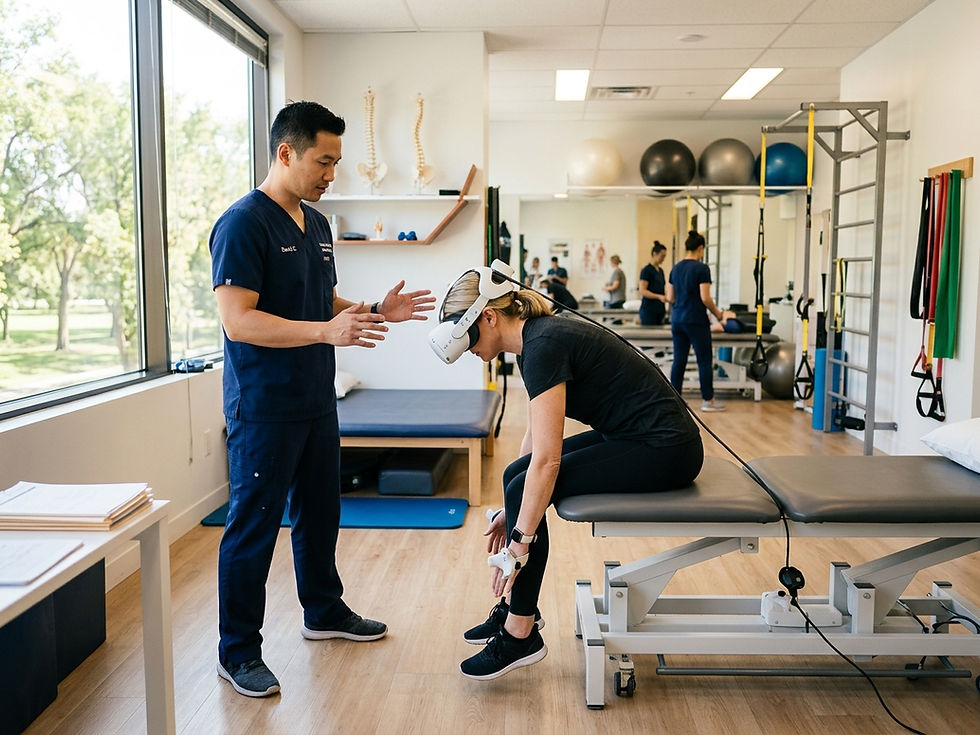
Thanks to virtual reality, the virtual representation of the patient's body performs a movement of greater amplitude, allowing them not to feel pain while having the sensation of having performed that movement. This gap between catastrophic anticipation and the real experience lived through the headset is precisely the central therapeutic mechanism.
VR provides the opportunity to apply graded exposure therapy, a form of rehabilitation that has demonstrated its effectiveness in low back pain patients presenting with high fear of movement.
In practice, your patient scans a visual horizon, catches virtual objects, twists their trunk in a game — without their brain immediately triggering the usual pain alarm. The reassociation movement = safety can then begin.
Virtual reality graded exposure therapy (VRGET) promises to overcome several major limitations of traditional exposure approaches, while incorporating real-time disability-oriented assessment and intervention.
The graded movement exposure protocol: how it works in practice
Graded exposure consists of establishing a hierarchy of activities that the patient fears and avoids. These fear hierarchies are individual-specific and associated with beliefs about the risk of injury during these activities.
In practice, here is how you can structure this work with KineQuantum:
1. Initial assessment: Before any session, assess the level of kinesiophobia using the TSK (Tampa Scale of Kinesiophobia) and functional disability using the ODI (Oswestry Disability Index — [Oswestry Disability Index]). These objective measures guide your clinical choices and provide evidence of your results. Find these VR physiotherapy assessments directly integrated into the platform.
2. Building the hierarchy: Together with your patient, you identify the movements they fear — bending forward, carrying a light load, performing a rotation — and rank them from least to most threatening.
3. Progressive exposure: The patient begins with the least anxiety-provoking scenarios in the virtual environment. With each session, you move up one level. The intensity of movements, range of motion and complexity of tasks progress in a controlled manner.
4. Correcting anticipation: Graded exposure protocols use successive participation in avoided activities to help patients overcome their apprehensions regarding feared movements and to encourage the resumption of activity. Each time anticipated pain fails to materialise, the erroneous belief weakens.
5. Transfer to the real world: VR is never an end in itself. After each virtual module, you guide your patient towards reproducing the same movement in the real space of your practice — the cognitive benefit is consolidated through concrete bodily experience.

Parameter | Value |
|---|---|
Level of kinesiophobia (TSK) | ≥ 37/68 (clinical threshold) |
Duration of a VR session | 15 to 25 minutes |
Recommended frequency | 2 to 3 times per week |
Typical number of sessions | 8 to 12 sessions |
Physiotherapy supervision | Systematic (active presence) |
Interim assessment | At session 4–5 (TSK + NRS) |
Gamified core strengthening and lumbar mobility exercises: why gamification changes everything
One of the classic barriers in lumbar spine rehabilitation is adherence. Your patients do their core exercises twice, then stop because they are repetitive, painful or discouraging.
Gamification — wrapping a therapeutic exercise in a game mechanic — directly addresses this problem.
Passive, active and gamified strategies have been used to promote the patient's intrinsic motivation from a psychological standpoint. In VR, a lumbopelvic stabilisation exercise becomes a mission, a score, a challenge to beat — your patient directs their attention towards an external goal rather than towards their painful sensation.
A fully immersive VR exercise game for patients with chronic non-specific low back pain produced significantly lower pain levels (NPRS) in the VR group compared to the control group.
A significant reduction in ODI scores was observed in the VR group over time (p = 0.008), which is consistent with a recent meta-analysis showing a significant reduction in disability in favour of VR compared to conventional treatments.
💡 Key takeaway: Gamification in VR is not a playful gadget. It is a clinical mechanism: it diverts attention away from pain, increases the number of useful repetitions per session, and maintains engagement throughout the programme. This is precisely what is missing from core exercises prescribed "at home".
Profile of patients most likely to benefit from lumbar VR
Not all of your low back pain patients derive the same benefit from VR. Here is the most favourable clinical profile:
Characteristic | Criterion |
|---|---|
Duration of symptoms | Chronic low back pain > 3 months |
Psychological profile | High kinesiophobia (TSK ≥ 37) |
Avoidance behaviour | Significant reduction in ADLs |
History | Partial failure of conventional rehabilitation |
Motivation | Active patient, willing to engage |
VR contraindications | Epilepsy, severe vestibular disorders, severe claustrophobia |
ADLs = activities of daily living.
These results indicate that virtual reality-based training can be effectively used in individuals with chronic low back pain in the short term, particularly to reduce pain, attenuate pain-related fear and improve disability.
⚠️ Key point: VR is a supplementary clinical tool, not a standalone treatment. VR makes sense when it serves a strategy — adherence, exposure, return to activity — not when it is expected to be a standalone solution. It is integrated into your overall care plan, as a complement to your manual therapy, therapeutic patient education and active exercises. Also consult the advantages of VR for physiotherapists page for a comprehensive overview.
What recent research says: the data consolidating your practice
The literature on VR and chronic low back pain has grown considerably since 2024.
A systematic review published in 2024 in the Journal of Medical Internet Research, covering 28 RCTs including 1,114 participants with chronic musculoskeletal pain, incorporated 25 trials into a meta-analysis evaluating VR on pain, functional disability and kinesiophobia.
A 2025 systematic review compiled the most recent data on the effectiveness of VR programmes on pain, disability, kinesiophobia and changes in thoraco-abdominal musculature in patients with chronic non-specific low back pain (CNSLBP).
A 2026 network meta-analysis is the first to compare and rank distinct VR modalities for chronic low back pain, providing a comparative ranking of 7 specific VR modalities — revealing that not all forms of VR are equally effective.
This last point is important for your practice: the quality of the clinical scenario and the alignment between the virtual exercise and the therapeutic objective matter as much as the headset itself.

How KineQuantum translates this science into concrete results
From research to your daily practice.
1. Lumbar scenarios designed for graded exposure — KineQuantum exercises for the lumbar spine in VR are structured in levels of progressive difficulty: range of motion, speed and task complexity adjust to the clinical condition of each patient, session by session.
2. Integrated objective monitoring — The platform records performance data at each session (range of motion, score, reaction time), allowing you to objectify progress with your patients and document your assessments. VR thus becomes a traceable tool for cervical spine and lumbar spine rehabilitation.
3. A tool adapted to private practice — With KineQuantum Liberté, the standalone device without cables or computer, you set up your patient in a matter of seconds and remain available to provide clinical supervision. Preparation time does not burden your workflow.
4. Sustained patient engagement — The gamified dimension of the exercises maintains motivation between sessions. Your patients return more consistently, which improves the effective therapeutic exposure dose — a determining variable in the rehabilitation of kinesiophobic low back pain patients.
5. Complementarity with your other approaches — Lumbar VR naturally articulates with your work in relaxation and chronic pain management, as well as with lower limb strengthening when the kinetic chain is involved.
Conclusion: restoring movement to its status as treatment
Chronic low back pain is above all a matter of meaning. Your patient has learned that moving causes pain, that movement is dangerous. Your role as a physiotherapist is to rewrite this equation.
VR, by creating a safe space where movement occurs without painful punishment, gives you an additional therapeutic lever. It does not replace your clinical expertise — it amplifies it.
Every session in which your patient successfully performs a movement they feared is a neurological victory as much as a mechanical one. And it is precisely this movement-safety reassociation that research today confirms as central to recovery from chronic low back pain.
VR technology in physiotherapy is no longer experimental: it is clinically documented, practicable in practice, and your patients embrace it enthusiastically.
FAQ
Is virtual reality effective for chronic low back pain?
VR can significantly reduce pain intensity and kinesiophobia in patients with chronic low back pain, both at the end of the intervention and at follow-up. The effects are particularly well documented on fear of movement as measured by the TSK. It is recommended as a complement to active rehabilitation supervised by a physiotherapist.
How does VR act on lumbar kinesiophobia?
Virtual reality allows the kinesiophobic patient not to feel pain while having the sensation of having performed a large-amplitude movement, thereby breaking the cycle of painful anticipation. This mechanism of dissociation between anticipation and real experience is at the heart of the effectiveness of graded exposure in VR.
What lumbar exercises can be performed in virtual reality?
VR exercises for the lumbar spine include active core tasks (lumbopelvic stabilisation), flexion-extension and rotation mobility, as well as functional scenarios (bending to pick up an object, lifting a virtual load). They are all calibrated on a clinical progression and supervised by the physiotherapist. Consult the lumbar spine VR page for further details.
Is VR rehabilitation suitable for older patients with low back pain?
Yes, provided that contraindications are respected (epilepsy, severe untreated vestibular disorders, severe claustrophobia). Scenarios are adjustable in intensity, duration and complexity. Fully immersive VR exercise interventions can improve patient engagement and clinical outcomes, including in populations less accustomed to digital environments, provided there is active support from the therapist.
How can VR be integrated into a lumbar physiotherapy session without extending the consultation?
In the majority of practices, the most viable format is a micro-module of a few minutes, followed by an immediate transfer to a real-world task. With a standalone device like KineQuantum, start-up takes less than a minute. A 15 to 20-minute module fits naturally into a 30 to 45-minute session, without sacrificing your manual therapy or educational work.
💡 Would you like to integrate lumbar spine rehabilitation in virtual reality into your practice or centre?
📚 References
[1] Li R., Li Y., Kong Y., Li H., Hu D., Fu C., Wei Q. (2024). Virtual Reality–Based Training in Chronic Low Back Pain: Systematic Review and Meta-Analysis of Randomized Controlled Trials. Journal of Medical Internet Research, 26, e45406. Voir l'article →
[2] Opara M., Kozinc Ž., Manojlović Ivezić D. (2024). Effects of virtual reality on pain, disability and kinesiophobia in patients with chronic low back pain: A systematic review with meta-analysis. Physical and Rehabilitation Medicine, PPR-230835. Voir l'article →
[3] Garcia-Baque R. et al. (2025). Effects of a Fully Immersive Virtual Reality Exercise Game on Fear of Movement, Pain, and Disability in People with Chronic Non-Specific Low Back Pain: A Pilot Randomized Controlled Trial. Healthcare, 14(16), 2641. Voir l'article →
[4] Kashyap R. et al. (2026). Efficacy of Various Virtual Reality Exposure Therapies for Chronic Low Back Pain: Systematic Review and Network Meta-Analysis. PubMed PMID 42489003. Voir l'article →
[5] Lopez-Morales F., Garcia-Baque R. et al. (2025). Effects of Virtual Reality on Adults Diagnosed with Chronic Non-Specific Low Back Pain: A Systematic Review. Healthcare, 13(11), 1328. Voir l'article →


Comments